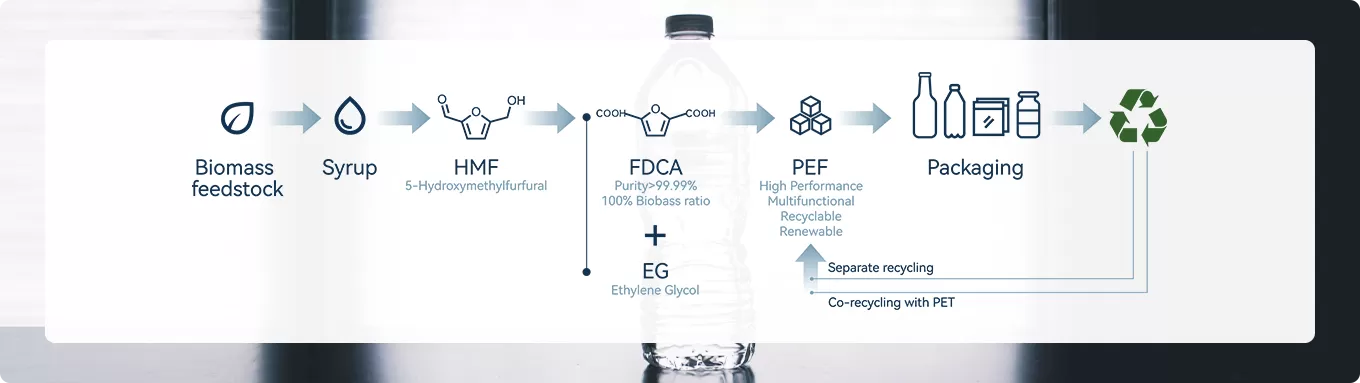
From Biomass to Packaging: A Circular Future
PEF vs. PET Performance Advantages with Practical Benefits
Solution Advantages
High barrier — Longer Shelf Life
O2 Barrier > 7× PET
H2O Barrier > 2× PET
CO2 Barrier > 15–20× PET
UV Shielding — Extends Shelf Life
1.5 mm PEF film near-zero UV transmittance
Superior UV Protection Compared to PET & Nylon
Recyclable — PET Recycling Systems-Compatible
PEF can be recycled independently or co-processed with PET, enabling a circular packaging lifecycle
Related Products & Use Cases
High-barrier packaging is essential for protecting products that are sensitive to oxygen, carbon dioxide, moisture, or aroma loss. FDCA-based PEF (Polyethylene Furanoate) offers a next-generation solution for brands seeking longer shelf life, lighter sustainable pef packaging materials, and lower environmental impact—without compromising performance.
These high barrier food packaging materials, based on advanced PEF material technology, have been trialed and commercialized in partnership with leading global beverage and specialty packaging materials brands.
What High-Barrier Packaging Products Can Be Made with PEF?
PEF can be processed using existing PET-compatible technologies, making it suitable for a wide range of commercial packaging formats: beverage bottles, food packaging bottles & containers, high-barrier films & laminates, fiber-based packaging with barrier liners, multilayer packaging structures
What High-Barrier Packaging Products Can Be Made with PEF?
Why Choose Bio‑Based Packaging Materials?
In today’s materials landscape, bio‑based packaging materials offer a unique combination of environmental responsibility and technical performance. Made from renewable feedstocks like FDCA and PEF polymers, these materials provide high‑barrier packaging performance for superior gas and moisture resistance. They are engineered to deliver reliability, recyclability, and compatibility with existing manufacturing systems.
FAQs
Q
What's the difference between PEF and traditional PET in barrier properties?
PEF has significantly better barrier properties: it offers over 7x oxygen, 15-20x CO₂, and 2x water vapor barrier performance compared to PET, making it ideal for high barrier packaging applications. As a fully bio-based polymer derived from plant-based feedstocks, PEF also supports brands’ sustainability and carbon-reduction goals.
Q
Is PEF recyclable? Can it be processed with PET?
Yes. PEF is recyclable either independently or co-processed with PET in existing recycling streams. It is compatible with current recycling infrastructure, making it a sustainable option as a bio based packaging material.
Q
What are the biomass sources of PEF?
PEF is made from renewable feedstocks such as fructose and glucose derived from agricultural residues or sugars.
Q
Can PEF packaging be customized for specific applications?
Absolutely. GS Biomats offers flexible customization of PEF packaging in terms of molecular weight, processing parameters, and application formats to meet various market and brand needs.